The right material for functional 3D printed parts is the one that survives your specific load case — mechanical stress, temperature, chemicals, UV or repeated flexion — at a printability you can actually achieve on your machine. There is no universal winner. PLA is the strongest of the common filaments in a pull test yet fails a warm car in an afternoon; ABS is weaker on paper but shrugs off heat; nylon is the mechanical workhorse but ruins itself if you leave it out of the dry box. Choosing well means matching the binding constraint of your part to a filament’s real, orientation-dependent properties — not to the single optimistic number on a technical data sheet.
That last point is the one most people get wrong, so we’ll start there before running through each material with the specifics you need to decide.
Datasheet numbers are optimistic — plan for anisotropy
FDM parts are highly anisotropic. A printed component is a stack of welded beads, and the bond between layers is never as strong as the polymer within a bead. Between those beads sit intrinsic voids from imperfect fusion. That is why an FDM part never matches the injection-moulded specimen a manufacturer used to measure tensile strength.
How much do you lose? Build orientation alone can roughly halve usable strength. Strength utilisation versus an injection-moulded reference has been measured at around 85.8% for edge-printed specimens but only 46.5% for parts printed upright, where the load pulls directly across the layer lines. The lesson is blunt: orient the part so the primary load runs along the beads, not across the layers.
Treat a TDS figure as method-specific, not a design value. Those numbers come from test bars printed under ideal conditions — sometimes annealed. An as-printed part in your real orientation, at your temperature and infill, will do less.
Material choice and design are two halves of the same decision. Get the geometry, wall count and orientation wrong and even PC will snap along a layer line. If you’re chasing bond strength specifically, our guide to fixing poor layer adhesion covers the settings that matter.
The common filaments, by binding constraint
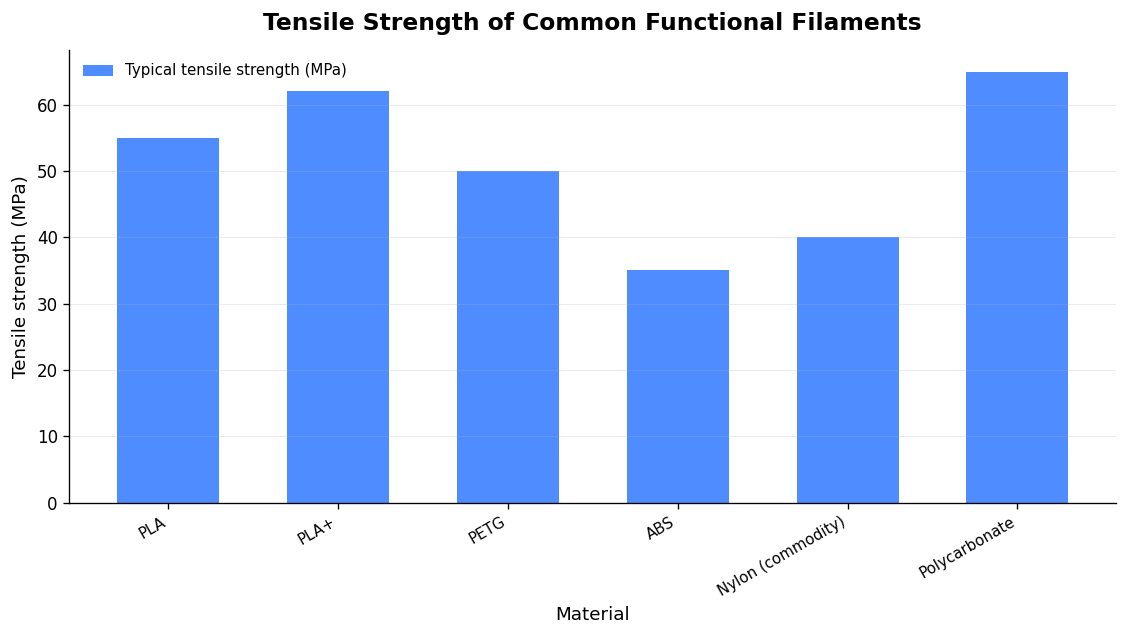
Here’s how the everyday materials compare on the properties that decide functional performance. Ranges reflect real grade-to-grade variation — quality filament sits at the top, budget spools at the bottom.
| Material | Tensile strength (MPa) | Elongation at break | HDT (°C) | Best functional use |
|---|---|---|---|---|
| PLA | 50–60 | 3–6% | 50–55 | Jigs, prototypes, indoor low-load |
| PLA+ | 60–65 | Higher than PLA | ~55 | Stiffer indoor parts |
| PETG | 45–55 | 15–25% | ~70 | Brackets, mounts, enclosures |
| ABS | 34–36 | Moderate | 95–100 | Heat-exposed, impact parts |
| ASA | ~ABS | Moderate | ~95 | Outdoor, UV-exposed parts |
| Nylon (PA6/PA12) | 32–48 (engineered 62–80) | High | Grade-dependent | Gears, bushings, hinges, snap-fits |
| Polycarbonate | 60–70 | Moderate | 110–130 | Toughest non-flexible parts |
| TPU 95A | Flexible | Very high | — | Bumpers, cases, flexible brackets |
PLA and PLA+: strong on paper, wrong for heat and load
PLA typically posts the highest tensile strength of the three most common filaments — around 50–60 MPa, with good spools hitting 55–60 MPa under ASTM D638. PLA+ pushes higher still, roughly 60–65 MPa. That makes it tempting for functional work, and for indoor jigs, fixtures and low-stress brackets it’s genuinely fine.
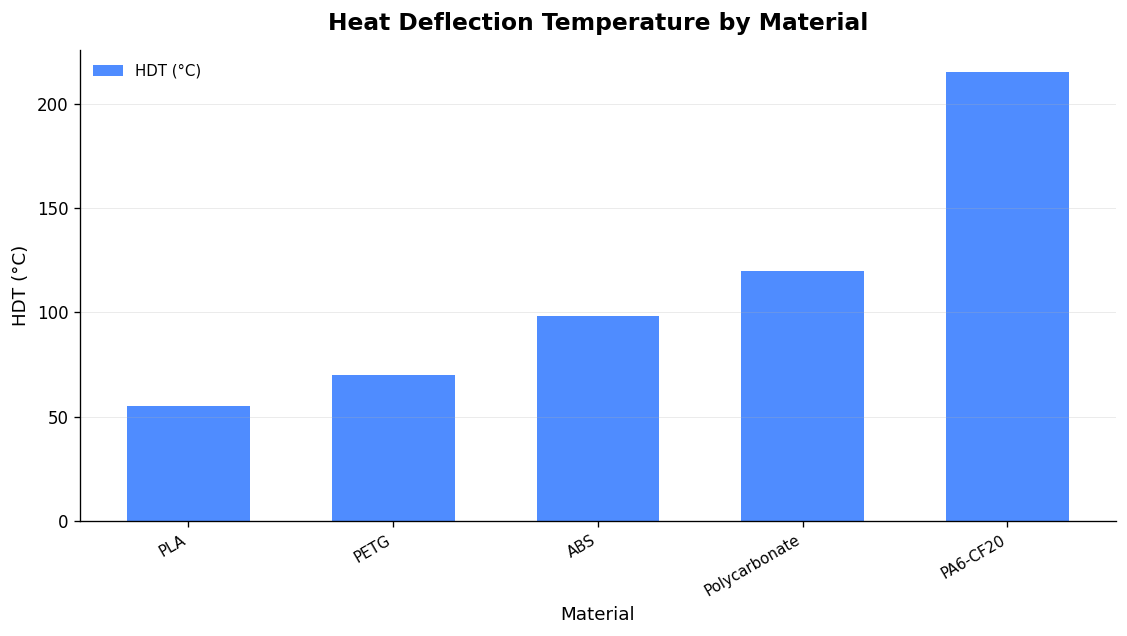
The problem is heat and creep. PLA’s heat deflection temperature averages about 56°C — some grades as low as 50–55°C. That’s why PLA dashboards and car-window mounts warp in summer. Worse for functional parts is creep: a PLA component under sustained load at 50°C will deform measurably over hours to days, and at 55°C that accelerates dramatically. If your part holds a spring, a clamp or any constant force in a warm environment, PLA will slowly let go. It’s also brittle, with elongation at break typically 3–6%, so it snaps rather than bends under shock.
PETG: the versatile default
For most durable, functional parts PETG is the sensible starting point. Tensile strength lands around 45–55 MPa, elongation at break is a tough 15–25%, and impact resistance is roughly 3–4× that of PLA — it bends and absorbs a knock instead of shattering. HDT sits near 70°C versus PLA’s 55°C, with a glass transition around 80°C, so it tolerates a warm car or an electronics enclosure that PLA wouldn’t survive.
It also has excellent chemical resistance, standing up to IPA, weak acids and household cleaners that stress-crack PLA and ABS, and it handles UV reasonably well. Brackets, mounts, protective covers and enclosures for heat-generating electronics are its home turf. If you’re deciding between the two everyday materials, our breakdown of PLA vs PETG settings for functional parts goes deeper on the tuning trade-offs.
ABS and ASA: heat and weather
ABS trades tensile strength — a modest 34–36 MPa — for superior impact strength and, crucially, heat resistance. Its HDT of ~98°C (at 0.45 MPa) means it handles nearly all consumer and light-industrial environments. You can also acetone vapour-smooth it to a near-injection-moulded finish. The catch: it softens near 95–105°C, warps badly without an enclosure, and smells while printing, so you need a chamber and decent airflow.
ASA is ABS with acrylate rubber replacing butadiene. Mechanically similar, but with roughly 10× the UV resistance — the reason it’s the pick for outdoor drone parts, garden fixtures and automotive exterior trim that lives in direct sunlight. It prints at 240–270°C nozzle and 100–110°C bed, warps strongly (enclosure mandatory), emits similar fumes to ABS, and costs more (around £20–32/kg).
Nylon (PA6, PA12): the mechanical workhorse
Where a part must survive repeated flexion, sliding wear or genuine mechanical load, nylon earns its place. It offers the best impact resistance of any non-flexible filament, excellent chemical resistance, and unusually good layer (vertical) strength — some grades are nearly as strong in Z as in XY, which partly sidesteps the anisotropy problem. Tensile strength is grade-dependent: commodity filaments run 32–48 MPa, engineered grades reach 62–80 MPa. Gears, bushings, hinges, living hinges and snap-fits that flex thousands of times are exactly where it shines.
The Achilles heel is moisture. Nylon is extremely hygroscopic — PA66 pulls enough water from the air in a few hours to matter. Store it sealed with desiccant, print from a dry box, and dry at 90°C for at least 4 hours beforehand. Printing damp nylon gives bubbles, stringing and brittle parts that defeat the whole point. Choosing between grades: PA6-CF is stiffer and more heat-resistant thanks to higher crystallinity, but more hygroscopic; PA12 is more dimensionally stable in humid conditions.
Fibre-reinforced (PA-CF, PETG-CF): stiffer, not automatically stronger
Chopped carbon or glass fibre adds stiffness and reduces warping, and for reinforced nylon the HDT gains are dramatic — Polymaker’s PA6-CF20 quotes a heat deflection temperature of 215°C, and other PA6-CF grades cite ~160°C. But fibre fill is not a free upgrade. It often sacrifices impact strength for negligible gains in ultimate strength, and can worsen inter-layer adhesion because fibres raise melt viscosity and disrupt bead fusion. Fibres are also abrasive, so a hardened steel or ruby nozzle is mandatory — brass wears out fast.
Annealing reinforced parts at 80–100°C for 2–6 hours can lift HDT and strength further, but expect 0.3–0.5% shrinkage in Z, so scale the model if tolerances are tight. Reach for CF when stiffness or dimensional stability under heat is the constraint — not as a blanket “make it stronger” button.
TPU: when flexibility is the function
TPU is for parts that must flex, absorb impact or resist abrasion — and it happens to have very high impact resistance and good resistance to oil and grease. Shore hardness sets the behaviour: 95A prints almost like PLA but bends (think firm shoe sole) and runs reliably on most direct-drive machines at 25–40 mm/s. 85A is soft rubber, needs a direct-drive extruder and slow speeds, and is worth the hassle only when you specifically need that softness.
95A is the sensible default: protective cases, drone bumpers and motor guards that survive crashes without tearing, and flexible brackets or living hinges that don’t fatigue. Print tips: with Bowden, drop to 15–20 mm/s and reduce retraction; limit the part-cooling fan to 20–30% to help layer bonding; run 220–240°C nozzle, 40–60°C bed. It’s hygroscopic — stringing is almost always wet filament, not retraction, so dry at 65–75°C for 6–8 hours. Note that standard TPU isn’t certified for food contact.
Polycarbonate and beyond
Polycarbonate sits at the top of the desktop pyramid: 60–70 MPa tensile — stronger than nylon and ABS — very high impact strength, HDT around 110–130°C, and optically clear or flame-retardant grades available. It’s arguably the toughest non-flexible filament you can print at home. It’s also demanding: a 300°C-capable hotend, an enclosure, thorough drying and a hardened nozzle, at £28–56/kg.
Above that, PEEK and Ultem (PEI) rival metals in some applications — PEEK handles sustained temperatures up to a 300°C HDT, and Ultem 1010 survives steam autoclaving. These need high-temperature extruders, heated chambers and controlled cooling from industrial systems; they are not desktop-friendly.
How to choose: match the constraint, then the design
Work through it in order:
- Identify the binding constraint. Is it heat, sustained load, impact, flexibility, UV or chemicals? That single question eliminates most of the list.
- Pick the material that clears it cheaply. Indoor and low-stress? PETG. Warm and impact-prone? ABS. Outdoors? ASA. Moving, wearing, repeatedly flexing? Nylon. Must flex? TPU 95A. Extreme heat or toughness? PC.
- Design for anisotropy. Orient so load runs along beads, add walls before infill (perimeters carry more structural load than a higher infill percentage), and generously fillet stress risers.
- Calibrate before you commit. Under-extrusion destroys layer bonds. Run a flow rate calibration in OrcaSlicer for any new spool.
For applications where all of this converges under real load — vibration, heat and repeatability — see our look at motorsport 3D printing in the UK, which shows where these materials genuinely earn their keep.
Frequently asked questions
What is the strongest material for functional 3D printed parts?
Among printable desktop materials, polycarbonate leads on combined tensile strength (60–70 MPa) and impact toughness, with engineered carbon-fibre nylon grades competing on stiffness and heat resistance. But “strongest” depends on the load: nylon wins for fatigue and impact, PLA+ posts high tensile numbers yet fails under heat. Match the property to your load case rather than chasing a single figure.
Is PETG or PLA better for functional parts?
PETG for almost anything that matters. It has 3–4× the impact resistance, a higher HDT (~70°C vs ~55°C), better chemical resistance and it bends instead of shattering. PLA only wins on raw tensile strength and print ease — fine for indoor jigs and prototypes, poor under heat or sustained load.
Why is my printed part weaker than the datasheet says?
Because datasheet numbers come from injection-moulded or ideally-printed test bars, and FDM parts are anisotropic with voids between layers. Printing upright can drop usable strength to under half the reference value. Reorient the part along the load path, increase wall count, and rule out under-extrusion or wet filament.
Do I need to dry filament for functional parts?
For nylon, TPU, PC and any CF grade, yes — always. These are hygroscopic, and moisture causes bubbles, stringing and brittle parts. Dry nylon at 90°C for 4+ hours, TPU at 65–75°C for 6–8 hours, and store sealed with desiccant.
Not sure which constraint is actually driving your part’s failure? Upload a photo of the break to Ask The Nozzle — the Diagnose tool identifies the defect and returns slicer-specific settings, including downloadable .ini patches for PrusaSlicer and OrcaSlicer.