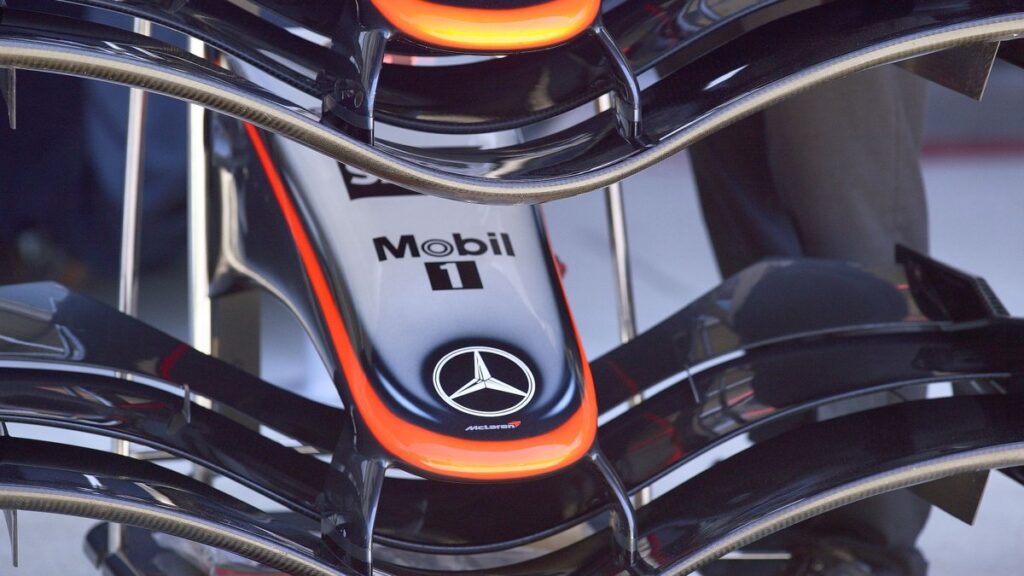
If you need SLS parts for a Formula 1 or top-flight motorsport programme in the UK, the shortlist that actually earns its place is short: Malcolm Nicholls Ltd (MNL), Graphite Additive Manufacturing, 3DDC and Prototal UK lead on genuine trackside track record, while 3DPRINTUK, LPE (Laser Prototypes Europe) and Protolabs cover volume, fine-feature and fast-quote work. This guide ranks them against what F1 supply actually demands — turnaround, material range, accreditation and finishing — and sets out the SLS material properties and design tolerances you need to hit before you send anything.
One caveat up front, because it changes how you read every claim below. Almost everyone answering the search who are the best UK companies for SLS printing for F1 parts is a service bureau, not a team. McLaren, Williams, Alpine and the rest run large in-house additive fleets and buy externally for overflow and specialist work. And within F1, polymer SLS is one process among several — it sits alongside SLA, FDM and metal AM (DMLS/SLM). At Alpine, for example, both SLA and SLS feed bodywork and internal structures. The headline aero and metal work often leans on SLA and metal powder-bed; polymer SLS earns its keep on ducting, housings, brackets, wind-tunnel model parts, jigs and low-volume functional components where its no-support freedom pays off.
Why SLS suits motorsport work
Selective laser sintering fuses nylon powder layer by layer with a laser, and the surrounding unsintered powder supports the part as it builds. That single mechanism drives most of the advantages a race engineer cares about:
- No support structures. Self-supporting geometry means internal channels, lattices and nested assemblies come out clean, with no support scars to dress off. For aero ducting and complex housings that is the whole game.
- Functional-grade nylon. PA12 and its filled variants give you parts you can bolt on and load, not just look at.
- Nesting for throughput. Because parts float in the powder bed, a build can be packed in three dimensions — useful when you need twenty variants of a bracket overnight.
The trade-off is surface finish (grainy as-sintered), orientation-dependent strength, and lower ductility than injection moulding. More on that below, because it bites people who spec SLS as if it behaves like moulded nylon.
The UK bureaus with real F1 credentials
Malcolm Nicholls Ltd (MNL) — Bidford-on-Avon, Warwickshire
MNL has supported UK automotive for over 53 years, working with OEM brands and F1 motorsport on highly finished interior and exterior trim, high-tolerance powertrain prototypes and low-volume pre-production parts. It is genuinely multi-process — SLA, SLS, FDM, vacuum casting and CNC under one roof — and runs two of the largest SLA machines in the UK, with an 800 × 800 × 600 mm build platform for oversized bodywork.
The reason to shortlist MNL for SLS specifically is the breadth of its material menu: PA 2200 (PA12), PA 3200 GF (glass-filled), PA 11, flame-retardant PA 2210 FR and PA 2241 FR, carbon-filled PA 603-CF, PA 12 Aluminium (Alumide), food-contact PA 12 and flexible TPU. That FR range matters for cockpit and enclosure parts where fire behaviour is a homologation issue. Note that the SLS system referenced on their site is an older HiQ Sinterstation, so if current hardware matters to your spec, confirm the machine directly.
Graphite Additive Manufacturing — Hertfordshire
Graphite AM’s earliest customers were F1 companies, and it still serves motorsport alongside automotive, UAV and aerospace. Two things set it apart. First, turnaround: the business explicitly re-tooled around F1’s on-demand tempo — a seven-to-ten-day quote loses that work — and after investing in a Vanguard SLS printer (build volume 370 × 320 × 445 mm) it can produce multiple graphite and carbon parts in a week, with some parts turned in under 24 hours.
Second, proprietary materials. Graphite AM has developed its own SLS blends loaded with fine graphite particles. Beyond anti-static behaviour, the graphite improves impact and thermal resistance up to 170°C, which suits lightweight, performance-critical parts near heat sources. Build capability runs from 1 to 10,000 units, so it scales from one-off to small series.
3DDC — Newport Pagnell, near Milton Keynes
3DDC is motorsport-first by origin — a Tier 1 supplier to Formula One, established 2007, positioned between London and Birmingham. Its distinctive capability is not raw SLS volume but the “Metalise it…” process: electroplating and metal-coating of polymer AM parts. Applying a composite metal skin to a sintered nylon part adds a structural coating as well as a cosmetic finish, and has been shown to improve strength, creep and ageing stability, plus resistance to moisture, temperature, humidity and corrosion.
For SLS work they run a ProMaker P1000. Read 3DDC as SLS-plus-metallisation for demanding motorsport parts rather than a high-volume pure sintering bureau — if you want a lightweight sintered part that behaves more like metal at the surface, this is the specialist.
Prototal UK (part of Prototal Industries)
Prototal UK has an explicit F1 record: parts from its HP Multi Jet Fusion, SLS and FDM machines have supported teams in Formula 1, GT3, GT4, touring cars, Formula E and more. The genuine differentiator for a motorsport or aero supply chain is accreditation — Prototal UK states it is the only AM company in the UK holding both EN 9100:2018 and ISO 13485:2016, alongside ISO 9001. If your programme demands documented process control, that combination is hard to match.
At group level, Prototal operates one of Europe’s most advanced SLS infrastructures on EOS hardware, with its biggest industrial platforms accommodating build volumes up to 700 × 380 × 580 mm depending on geometry, and serial runs up to 100,000 parts. Its motorsport material talk includes carbon-filled nylon and Carbon PEEK for engine mounts, suspension parts and aero components — but note Carbon PEEK is typically an FDM material, not SLS, so confirm the process for any given part.
Strong SLS bureaus that are less specifically F1
3DPRINTUK — London
3DPRINTUK claims the largest UK powder-bed capacity, running a bank of EOS P110 SLS machines (pages variously cite 11 or 12 systems) printing at 100-micron resolution with layer-blending for consistent surface quality, in PA12 (PA2200) and flexible TPU. It also operates SAF (Stratasys H350) and HP MJF 5210. Max single-piece SLS part size is 236 × 186 × 300 mm, with minimum wall 1 mm unpolished / 2 mm polished. It is geared more to volume, consumer and cycling work than to F1 specifically — but for repeatable batches at a keen price, it’s a serious option.
LPE (Laser Prototypes Europe) — Belfast
Founded in 1991, LPE is one of the UK and Ireland’s longest-established bureaus, with specialist SLS prototyping and low-volume production and deep roots in medical, automotive and aerospace. It offers one of the widest process ranges in plastics and metals — SLA, SLS, DMLS and DLP — and its EOS Formiga P100 delivers fine-feature capability down to 0.4 mm wall thickness, useful for delicate ducting and clip features.
Protolabs — Telford, Shropshire
Protolabs runs industrial SLS for precision prototypes and functional production parts on a fast digital-quote model. Broad and quick, but not motorsport-specialised — best when you want a part quoted and made without a long conversation.
SLS materials: the numbers that actually matter
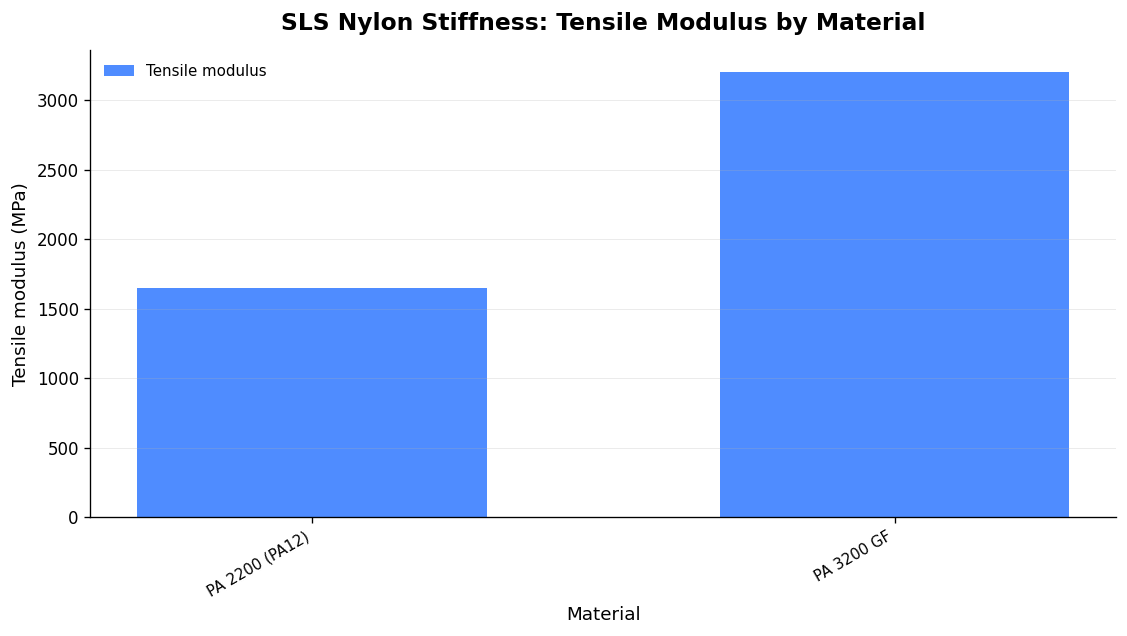
Spec the material to the load and temperature, not the brochure. The verified figures below are the ones to design against. As always, our load-based guide to picking the right filament is the right mental model for choosing between these.
| Material | Tensile modulus | Tensile strength | Notable property | Typical use |
|---|---|---|---|---|
| PA 2200 (PA12) | 1650 MPa | 48 MPa (xy) | Melt temp 176°C, density 930 kg/m³, strain at break 18% | General functional parts, ducting, housings |
| PA 3200 GF (30% glass bead) | 3200 MPa | 51 MPa | High stiffness, wear and heat resistance; reduced ductility | Stiff housings, bearing housings, thermally loaded parts |
| Graphite AM graphite blend | — | — | Anti-static; thermal resistance to 170°C; improved impact | Lightweight performance-critical parts near heat |
| PA 11 | — | — | Tougher, more ductile, bio-based feedstock | Parts needing impact and elongation |
| Alumide (Al-filled PA12) | — | — | Stiff but brittle fracture | Rigid tooling, jigs, cosmetic metallic look |
Two things trip up experienced engineers here. First, orientation dependence. Because the laser traces orthogonal paths during exposure, mechanical properties vary with build orientation — the 48 MPa PA12 figure is the xy direction; z-axis strength is lower. Independent testing put average strength around 46 MPa, close to the datasheet 48 MPa, so the headline number is honest — but only in the strong direction. Orient load-bearing features accordingly, and treat SLS layer bonding the same way you would when trying to bond layers on an FFF print: the interface is the weak axis.
Second, ductility. Powder-bed PA12 fails at low strain to failure compared with injection-moulded nylon — it is more brittle than moulded parts of the same polymer. Glass fill (PA 3200 GF) buys you stiffness and heat resistance but costs you more ductility again; Alumide fractures in a brittle manner where PA2200 would fail ductile. If a part must flex or take impact, reach for PA 11 rather than filled grades. And for cockpit or enclosure parts where fire behaviour is homologated, the FR grades (PA 2210 FR / PA 2241 FR) exist for exactly that reason.
Tolerances and design rules to hit before you send
SLS is dimensionally good but not CNC-good. Design within these and you’ll get parts that fit first time:
- Accuracy: expect roughly ±0.1 mm or 0.1%, with guaranteed tolerances around ±0.3 mm or 0.3% when you stay within recommended guidelines (3DPRINTUK figures for PA12).
- Fit clearance: for a shaft into a hole, allow 0.15 mm between surfaces — that is 0.3 mm on diameters. Skip this and you’ll be reaming sintered nylon by hand.
- Minimum wall: bureau-dependent, from about 0.4 mm on fine-feature machines (LPE’s Formiga P100) up to 1 mm unpolished / 2 mm polished at 3DPRINTUK. Ask before you thin a wall.
Whatever you send, run the file through a pre-flight check first — wall thickness, trapped volumes and orientation flags are exactly the sort of thing that turns a quote around faster and stops a bureau bouncing your geometry.
How to choose between them
Match the bureau to the constraint that’s actually binding your programme:
- Fastest turnaround: Graphite AM (sub-24-hour on some parts, built specifically around F1’s tempo).
- Widest SLS material menu, including FR: MNL.
- Documented quality for aero/medical-grade supply chains: Prototal UK (EN 9100 + ISO 13485 + ISO 9001).
- Metallised sintered parts: 3DDC.
- Volume batches at price: 3DPRINTUK.
- Fine features and multi-process flexibility: LPE.
FAQ
Is SLS or metal AM better for F1 parts?
Different jobs. Polymer SLS wins on lightweight, complex, self-supporting geometry — ducting, housings, wind-tunnel model parts, brackets. Metal AM (DMLS/SLM) is for structural and high-temperature parts that must survive real mechanical and thermal load. Teams use both, and SLA for smooth cosmetic and fluid-flow surfaces.
What SLS material should I use for a load-bearing motorsport bracket?
Start with PA12 (PA 2200) and orient the load along the strong xy direction. If you need more stiffness and heat resistance, move to glass-filled PA 3200 GF, accepting lower ductility. If impact or flex is the concern, PA 11 is tougher. For anything near a heat source, ask about Graphite AM’s blends (rated to ~170°C).
How accurate is SLS?
Expect roughly ±0.1 mm or 0.1% typical, and design to guaranteed tolerances of about ±0.3 mm or 0.3%. Allow 0.15 mm surface clearance (0.3 mm on diameters) for mating parts.
Do these bureaus work directly with F1 teams?
They supply teams and Tier 1 motorsport customers, typically for overflow and specialist work — the teams run their own in-house AM fleets. 3DDC and Graphite AM have the most explicit F1 pedigree; Prototal UK brings the accreditation supply chains demand.
Whichever bureau you pick, the parts still start with a good file and the right material choice — that’s where Ask The Nozzle watches your back, so you’re not paying bureau rates to find out a wall was too thin or the orientation was wrong.