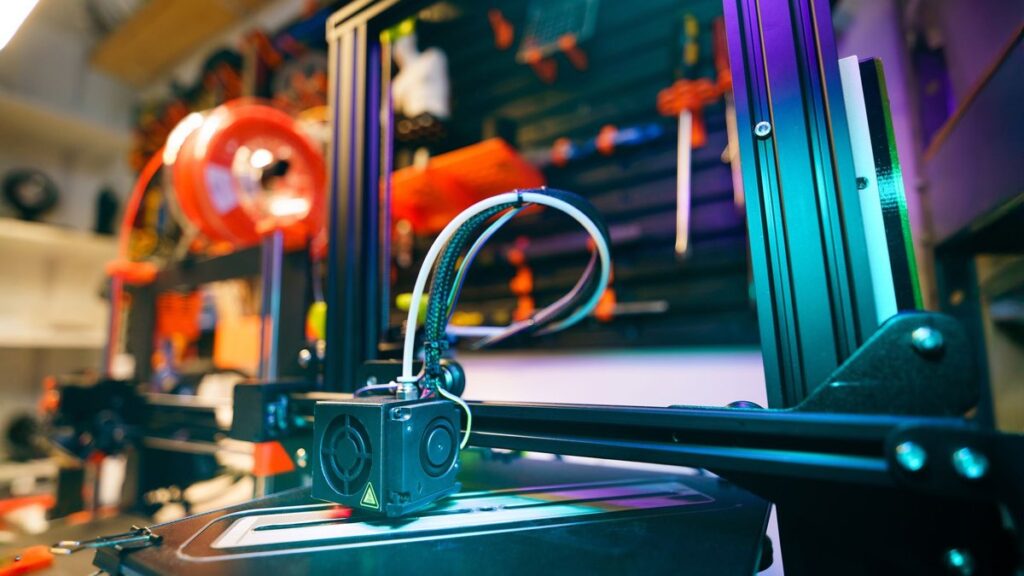
A quick clarification before anything else: there is no recognised “F1 grade” standard for food-contact 3D printing. If you searched for f1 grade 3D printing services UK, you almost certainly mean food-grade — parts that can legally and safely touch food. That’s the topic here, and it’s worth getting the terminology right because the whole field turns on precise distinctions that filament marketing routinely blurs.
The single most important one: a food-safe material is not the same thing as a food-safe part. PLA, PETG and PA12 can all be made from non-toxic polymers, but the object you print from them can still fail food-contact requirements. Understanding why — and what a UK bureau can and can’t certify — is what saves you from a part that looks clean and still harbours bacteria or leaches into food.
Food-safe material vs food-safe part: the distinction that matters
Food-grade certification almost always applies to the raw material — the filament, powder or resin — not the finished object. That’s deliberate. The printing stage introduces too many variables (temperature, layer bonding, nozzle wear, cross-contamination) for a material certificate to cover the part that comes off the plate. The polymer supplier can certify the pellet; only you, as the manufacturer using the part, can demonstrate the finished article is safe in its actual application.
Two independent contamination vectors are in play, and you have to close both:
- The material itself — dyes and additives in the filament, the nozzle alloy, support material. A “pure” PLA polymer is generally non-toxic, but the coloured spool on your shelf may contain pigments and additives that are not food-approved.
- Structural porosity — the microscopic gaps inherent to layer-by-layer deposition. This is the vector most people miss, and it’s the root cause of nearly every food-safety failure in FFF parts.
The mechanism of concern for the material side is migration: small amounts of chemical components transferring from the plastic into the food, especially as the part degrades or reacts over time. Most filaments and resins are formulated for strength, accuracy or surface finish — not validated against food-contact migration limits.
The porosity problem no calibration can fix
No matter how dialled-in your printer, FFF creates a microporous structure — horizontal gaps between layers and vertical channels between extrusion lines. On a well-printed part these are invisible, but they are exactly where moisture ingresses, biofilms form and bacteria hide. Surface sanitising doesn’t reach them, so wiping down a printed part is not equivalent to cleaning a moulded one.
This isn’t unique to FDM. SLS parts in PA12 are porous by nature too — which is why UK SLS bureaux will often confirm PA12 is biocompatible and “food safe under certain conditions” but decline to certify the finished part as food safe. The porosity is a property of the process, not a defect.
The exception is metal. 3D-printed 316L stainless steel comes out over 99% solid via DMLS and behaves essentially like a fabricated part. If you genuinely need a durable, washdown, repeated-contact food part, metal is the honest answer — polymer FFF is not.
Rule of thumb: if the part will be washed and reused for food contact, either print it in 316L, seal it completely with a compliant coating, or treat it as single-use.
The regulatory framework: UK, EU and US
You can’t claim “food safe” in the abstract. Compliance is defined by specific legislation, and UK law is largely retained EU law.
| Region | Governing rule | What it requires |
|---|---|---|
| EU / UK | Regulation (EC) No 1935/2004 | Materials must not transfer substances to food in quantities that endanger health or change its composition, taste or smell. |
| UK enforcement | Food Contact Materials (England) Regulations 2012 | Enforces the EU rules; FSA (England, Wales, NI) and Food Standards Scotland oversee policy. Manufacturers must show due diligence. |
| EU plastics | Regulation (EU) No 10/2011 | Sets requirements for plastics in food contact, including migration limits. |
| EU manufacturing | Regulation (EC) No 2023/2006 (GMP) | Good Manufacturing Practice — the material must be produced in line with this to be truly food-safe. |
| US (equivalence marker) | FD&C Act, Title 21 CFR | Administered by the FDA. Manufacturers self-assess formulation against the regulation. |
Two numbers you should know from 10/2011: an overall migration limit of 10 mg/dm² and a specific migration limit (SML) that applies to the final article in contact with food. These are tested on the finished part under realistic conditions, which is precisely why a material certificate alone isn’t enough.
A word on “FDA approved” — it’s a misnomer. The FDA does not approve, certify or issue a seal for specific products. A manufacturer evaluates its formulation against the regulation and, if it meets the requirements, states the material is formulated to comply. Treat any supplier claiming an “FDA-approved filament” with caution; that’s not how it works.
For equipment rather than direct contact, the relevant marks are NSF: NSF/ANSI 51 covers materials and finishes in food equipment (indirect contact), and NSF 61 covers drinking-water contact. If you’re printing a part that sits inside a machine rather than touching food directly, 51 is the standard to ask about.
Materials: what UK bureaux actually use, and the trade-offs
The realistic material list for food work spans FFF filaments, SLS powders and metal. Here’s how the common options compare on the properties that decide suitability.
| Material | Process | Max service temp | Notes for food contact |
|---|---|---|---|
| PLA | FFF | ~50–60 °C (softens above ~55 °C) | Pure polymer non-toxic, but dyes/additives may not be food-safe. Porous; too heat-sensitive to survive a dishwasher. |
| PETG | FFF | Higher than PLA | Can be food-safe as a material; the printed object is a separate question. Typical print settings: nozzle 240–245 °C, bed 80–90 °C (one vendor’s guidance). |
| ABS / ASA (some brands) | FFF | Higher | Acetone vapour smoothing fuses the surface and removes layer lines — a genuine porosity fix on ABS. |
| PEI / ULTEM 1010 | FFF | Very high | FDA-compliant with strong mechanicals, but needs processing above 300 °C — specialist hardware only. |
| Food Grade PA12 (Blue) | SLS | Cleaning cycles up to 100 °C | Meets EU 10/2011 / FDA contact standards, flame-retardant to UL94-V0, supplied in industry-standard blue. Standard PA12 ≈ 45–48 MPa tensile, 15–20% elongation. |
| 316L Stainless Steel | DMLS | Very high | Over 99% solid — effectively equivalent to fabricated metal. The right choice for durable washdown parts. |
A few practitioner notes on this table. The dishwasher caveat catches people out: PET, nylon and PLA soften and distort around 60–70 °C, so anything that goes through a wash cycle rules them out. That’s a big reason Food Grade PA12 (rated for cleaning up to 100 °C) and 316L dominate reusable applications.
The blue colour of food-grade PA12 isn’t cosmetic — it’s the detectable-colour principle from food manufacturing. Blue rarely occurs in food, so a fragment that breaks off is visible on an inspection line. Expect that convention if you order SLS parts for a processing environment.
For moving parts in food machinery — bushings, gears, gripper jaws — look at tribologically-optimised food-grade materials such as igus’s food-grade filament, SLS powder and resin. These have solid lubricants built in so they run dry, and crucially they’re formulated to survive constant motion, washdown and abrasion without shedding particles. A part only qualifies when the polymer is certified under FDA guidelines and EU 10/2011 and it can physically survive the line.
Sealing and coating: the standard fix for porosity
Because porosity is a process property, the practical route to a food-safe polymer part is usually to seal it. Two-part epoxy resin is the most reliable method: it fills the layer lines completely, self-levels to a smooth glossy finish and forms a fully non-porous barrier. Cure time runs 24–72 hours depending on the product, after which food-grade epoxies comply with FDA 21 CFR 175.300 — the rule governing coating chemistry for food contact.
Not all coating specs are equal. Epoxies meeting 175.300 represent a higher standard than 175.105: they must pass extractables testing (limited to less than 0.5 mg/in² after solvent and elevated-temperature exposure) plus toxicological evaluation of the cured specimen. If a supplier quotes a coating, ask which CFR section it meets.
One important limit: food-contact compliance addresses chemical migration, not mechanical durability. A resin surface can be fully 175.300-compliant and still be a terrible cutting-board surface, because knife strokes carve grooves that then harbour bacteria. Compliance ≠ fit for purpose.
Hardware and process mistakes that void food safety
Even with the right material, the print environment can contaminate the part. The common failures:
- Nozzle alloy. Avoid brass nozzles — they can contain lead. Use a dedicated stainless steel nozzle for all food-contact work. Food-grade filaments carry no abrasive composite particles, so nozzle wear-into-print isn’t the issue here; leaching is.
- Cross-contamination. Don’t run food-grade material in a multi-material job alongside non-food-grade material — mixing can’t be ruled out. Support material must be either food-grade or the same material as the part.
- Bed prep. Use a clean glass plate with no adhesive, or a food-grade adhesive only.
- Speed. Slower printing improves layer adhesion and reduces the gaps that bacteria colonise — the opposite of what you’d optimise for throughput.
That last point is a good example of why it pays to check the part before you commit hours to a print. Our G-code pre-flight checker and the conversational Ask advisor exist to catch settings problems — like a wall/speed combination that leaves your food part porous — before the plate starts. It watches your back on exactly the kind of quiet failure that doesn’t show up until the part’s in service.
Choosing a UK bureau: what to ask for
A capable UK service will offer material certificates for options such as Ultem 1010 and ABS M30i (FDM), PA2200 / Food Grade PA12 (SLS) and 316L stainless (DMLS), plus finishing like vapour or vibro smoothing. What separates a good supplier is honesty about the boundary: they’ll certify the material and describe the validated workflow, but they’ll tell you the finished-part compliance and due diligence sit with you.
If your application is functional and structural rather than food-specific, our write-ups on the materials, processes and rules that actually matter and the UK SLS bureau shortlist cover how to brief a service and read a spec sheet — much of that transfers directly to food-grade work.
FAQ
Is PLA food safe for a 3D-printed cup or bowl?
The pure PLA polymer is generally non-toxic, but the printed object usually isn’t food-safe as-is: dyes and additives in the filament may not be approved, the surface is porous, and PLA softens around 50–60 °C so it can’t be dishwashed. Seal it with a 21 CFR 175.300-compliant epoxy, use a stainless nozzle, or treat it as single-use.
Why won’t SLS bureaux certify PA12 parts as food safe?
Because the SLS process produces inherently porous parts. The PA12 material can be biocompatible and food-safe under certain conditions, but the porosity means the finished part can’t be certified as food safe without further validation. Food Grade PA12 Blue is the exception designed for this, rated for cleaning up to 100 °C and meeting EU 10/2011.
Does “FDA approved filament” mean my part is legal to use with food?
No. The FDA doesn’t approve or certify specific products — there’s no seal or registration number. A material can be “formulated to comply” with the relevant CFR, but the finished part must still meet migration limits (10 mg/dm² overall under EU 10/2011) and you must demonstrate due diligence for its actual use.
What’s the most durable option for reusable food-contact parts?
3D-printed 316L stainless steel, which comes out over 99% solid and behaves like fabricated metal — it survives washdown, heat and repeated contact. Among polymers, Food Grade PA12 Blue (cleaning cycles to 100 °C) is the strongest reusable option; sealed FFF parts sit below both.