In a modern Formula 1 car, additive manufacturing does two jobs that nothing else does as well: it consolidates several machined components into a single printed part, and it turns a wind-tunnel design change into a physical part in days rather than weeks. Metal AM lets you print geometries you cannot machine — internal cooling channels, lattice-lightened structures, load paths that follow the stress rather than the tooling. That is why motorsport additive manufacturing has moved from a prototyping curiosity to a core production process, with teams printing hundreds of on-car metal parts and tens of thousands of polymer aero parts a season.
But the value is specific, not universal. AM earns its place where geometry, lead time or part-count consolidation matter more than raw throughput or the fatigue certainty of a forging. Below is what a practitioner needs to know: the processes, the alloys and polymers actually in use, the post-processing that makes load-bearing metal parts safe, and the FIA rules that decide what you are even allowed to print.
Which processes motorsport actually uses
There is no single “3D printer” in a race team. The technology splits cleanly by material and by job.
Metal: powder-bed fusion dominates
Selective laser melting (SLM) — also called laser powder-bed fusion (PBF-LB) — is the workhorse for structural metal parts. A thin layer of metal powder is spread on the build plate and selectively fused with a high-powered laser, layer by layer. Electron beam melting (EBM) works the same way but uses an electron beam; it runs hotter, which reduces residual stress but limits fine detail. Binder jetting glues powder with an adhesive and then sinters it — faster and cheaper, but you start with roughly 5% porosity after sintering, so densification steps are effectively mandatory for any structural application.
Polymer: the bigger volume, quietly
The largest number of printed parts on a race programme are polymers, not metals — overwhelmingly for the wind tunnel. SLA (stereolithography) produces the high-detail, dimensionally stable aero surfaces; SLS (selective laser sintering) handles tougher functional parts and on-car ducts; FDM/FFF covers jigs, brackets and supports; and PolyJet handles fine multi-material detail. SLA and SLS win over FDM here because they render complex geometry and fine features without the layer-adhesion and porosity penalties of extrusion.
The metals — and the alloys that survive
The alloy list in motorsport is short and deliberate. Each material earns its slot for a specific mechanical reason.
| Alloy | Type | Why it’s used | Typical parts |
|---|---|---|---|
| Ti-6Al-4V (Ti64) | Titanium | Excellent strength-to-weight, corrosion resistance | Structural, suspension, brackets |
| AlSi10Mg | Aluminium | Lightweight, good mechanicals, well-characterised for LPBF | Structural, cooling circuits |
| Inconel 718 | Nickel superalloy | High-temperature strength under stress | Exhausts, turbochargers |
| Scalmalloy / HRL 7A77 | Al-Mg high-strength | Superior strength-to-weight vs standard Al | Highly loaded structural |
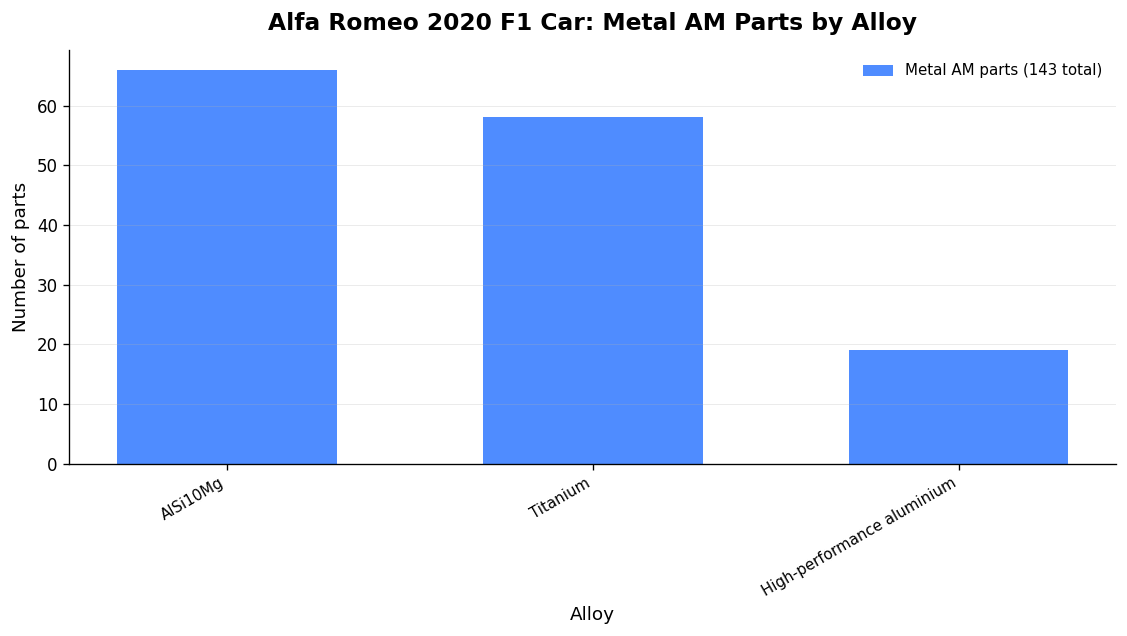
Scale is real. In 2020, Alfa Romeo’s Orlen car ran 143 metal AM parts: 58 in titanium, 19 in high-performance aluminium and 66 in AlSi10Mg. The typical F1 metal AM part list reads: chassis inserts, cooling-circuit ducts, safety structures, electronic-component mounts, plus exhausts, engine parts and suspension elements. If you’re choosing engineering-grade materials for load paths on your own machine, our load-based guide to picking the right filament applies the same reasoning at the desktop scale.
Polymers and composites — read the porosity numbers
High-temperature polymers cover the hot-adjacent, non-structural or lightly-loaded parts. The two you’ll see named most are the PEI grades.
| Property | ULTEM 9085 (PEI) | ULTEM 1010 (PEI) |
|---|---|---|
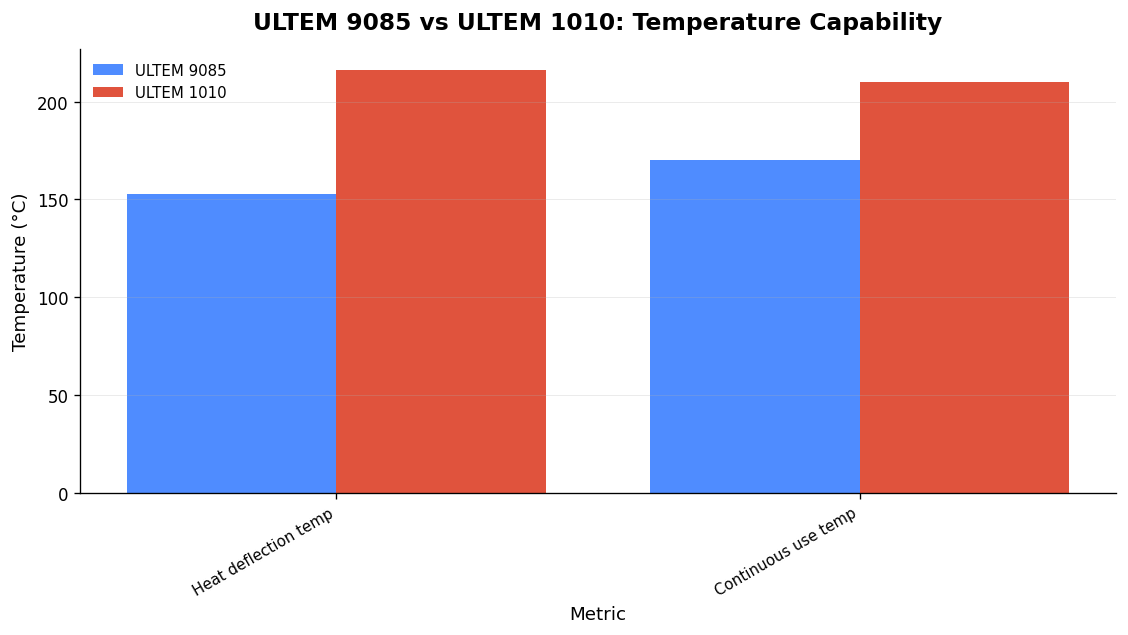
| Heat deflection temp (HDT) | ~153 °C | ~216 °C |
| Continuous use temp | ~170 °C | ~210 °C |
| FST certified (FAR 25.853) | Yes | No (not out of the box) |
| Tensile strength (ISO 527, FFF) | ~69.7 MPa | Higher |
| Flammability | UL94 V-0; EN45545 (rail) | — |
ULTEM 9085 is the FST-certified default — flame, smoke and toxicity compliant for cabin interiors — and prints at roughly 335–350 °C in a heated chamber. ULTEM 1010 is stronger and hotter but not FST-certified as printed. PEEK beats both on impact strength and usable temperature but costs many times more; where the extra margin isn’t needed, ULTEM is the cost-effective call. Visa Cash App RB, for example, prints Carbon-PEEK brake cooling ducts on a Roboze Argo 500 to cut cost and lead time.
The accuracy flag that catches people out: FDM parts in fibre-filled high-temp polymer are not fully dense. A NASA study of FDM Ultem 1000 with fibre fill measured porosity of 25–31%. Porosity drives structural performance, so never treat an FDM carbon-filled bracket as if it had the properties of the neat resin’s datasheet.
Post-processing: HIP is what makes metal AM safe to load
As-built powder-bed metal contains gas pores and lack-of-fusion defects that wreck fatigue life. Hot isostatic pressing (HIP) — high temperature plus high isostatic gas pressure — closes internal porosity and is the difference between a decorative part and one you’d bolt to a suspension.
For binder-jet Ti-6Al-4V, studied cycles include a standard 920 °C / 100 MPa for 4 h and a high-pressure/low-temperature (HIP-HPLT) route of 850 °C / 200 MPa for 2 h. Independent datasets show HIP’d AM Ti-6Al-4V reaching fatigue performance comparable to wrought material, largely independent of the initial defect population. For AlSi10Mg made by LPBF, HIP followed by a T6 heat treatment improves fatigue resistance, hardness, tensile strength and residual stress versus the stress-relieved condition.
Two nuances a knowledgeable reader must respect:
- HIP is not a universal fix. Fatigue performance still depends on as-built quality, and parameters outside ASTM recommendations (lower temperature, higher pressure) delivered significantly better fatigue in testing. Assuming HIP restores full fatigue life risks catastrophic failure in fracture-critical parts.
- Powder reuse degrades results. For AlSi10Mg, fresh powder gave the best mechanicals and lowest porosity; stored and reused powder gave inferior properties and more porosity. Track your powder lot, not just your machine.
This is the same discipline that separates a part that survives the car from one that doesn’t — a point covered well in GMR’s write-up on how a part goes from CAD to a component that survives the car.
The FIA rules that decide what you can print
In F1, AM is permitted only where the regulations explicitly allow it, and the allowed materials are enumerated. The 2021 approved list covered titanium alloys (Grade 1, Grade 2, Ti6Al4V, Ti 5553, Ti 6242) and steels (316, 304, MS1, 15-5PH, 17-4PH, 300M, 4140).
The 2026 regulations expand AM significantly — most notably, suspension uprights may now be additively manufactured in titanium or aluminium. Permitted upright titanium grades add Ti6Al4V ELI to the earlier list; permitted aluminium alloys include AlSi10Mg, AlSi7Mg, Al Cl−30AL, P339 AM, EOS Aluminium 2139 AM and Aheadd CP1, with A20X, particulate-reinforced 2024-RAM2 / 6061-RAM2 (Elementum3D), and the Al-Mg alloys Scalmalloy and HRL 7A77 also allowed.
Two AM-specific rules worth memorising:
- The finished mass of an AM component must be at least 60% of the mass of the printed component (excluding supports) — a limit on how much machining-away is permitted.
- AM materials containing beryllium are prohibited on health-and-safety grounds.
And a useful counter-example: certain skid/plank titanium parts must be made to AMS4928 or AMS4911 (annealed), machined from solid only, with no forging, rolling, welding, heat treatment or coating — AM is explicitly banned there. The upright itself is regulator-defined: it provides mounting, kinematic restraint and the load paths from wheel axle to outboard suspension attachments and reacts brake-caliper loads, with only one upright per complete wheel.
Where the volume — and the money — really is
The headline metal parts get attention, but the wind tunnel is where AM volume lives. McLaren produces up to 9,000 parts a year across its front and rear wing programmes and large bodywork on five Neo800 SLA systems, running 60%-scale models, using Somos PerFORM Reflect resin developed for wind-tunnel work that cuts post-processing time by 30%. Alpine prints around 25,000 parts annually across six SLA and three SLS machines; Pat Warner puts wind-tunnel demand at roughly 600 AM parts per week handled by a five-person team.
The cost case is stark where it applies. McLaren’s front brake ducts came out 60% faster on lead time and 86% cheaper via AM — and the team only makes two or three sections of a given duct design per year, which is exactly the low-volume, high-iteration profile AM suits. For a wider view of where UK additive manufacturing earns its keep, see our overview of motorsport 3D printing in the UK and the practitioner’s shortlist of UK SLS suppliers.
The honest caveat
Metal AM is still well under 1% of the total metal manufacturing market. Processes can be less than fully robust and repeatable, which means some trial-and-error and, part-for-part, lower quality than machined-from-billet or forged components, with limited throughput. That’s the trade you accept for geometry and lead time. The winning strategy isn’t “print everything” — it’s printing the parts where consolidation, internal channels or iteration speed pay for the process risk, and machining or forging the rest.
FAQ
What metal is most used in motorsport additive manufacturing?
Ti-6Al-4V (Ti64) for strength-to-weight and corrosion resistance, AlSi10Mg for lightweight structural parts, and Inconel 718 for high-temperature parts such as exhausts and turbochargers. High-strength Al-Mg alloys like Scalmalloy appear where strength-to-weight is critical.
Is 3D-printed metal strong enough for load-bearing race parts?
With correct post-processing, yes. HIP’d AM Ti-6Al-4V can reach fatigue performance comparable to wrought material. But fatigue still depends on as-built quality and powder condition, so HIP is not a blanket guarantee — fracture-critical parts need validated parameters and testing, not datasheet optimism.
Can F1 teams 3D print suspension uprights?
From the 2026 regulations, yes — uprights may be additively manufactured in listed titanium or aluminium alloys. Previously AM was restricted to other components. Note that some parts, such as certain skid/plank titanium pieces, must still be machined from solid and cannot be AM.
Why do teams print so many polymer parts?
Wind-tunnel aero development. SLA and SLS produce hundreds of scale-model parts per week with the geometry and surface detail aero testing needs, at a lead time and cost that retooling cannot match — McLaren reports up to 9,000 parts a year, Alpine around 25,000.