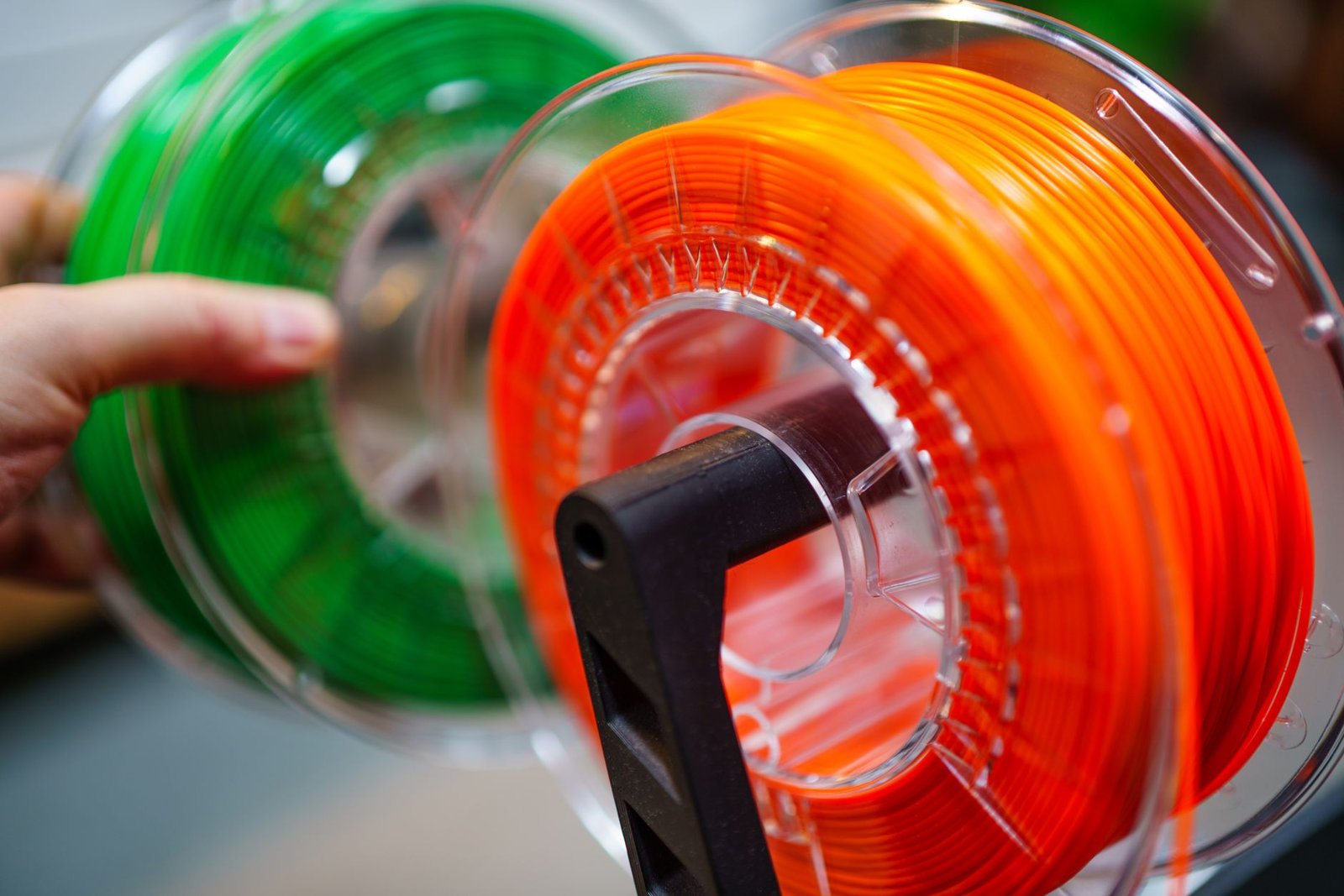
Dry filament extrudes as a smooth, glossy, consistent noodle; wet filament pops, hisses and comes out matte, rough or bubbly. If you want the short version of how to dry filament: hold the spool above room temperature — but below its glass transition point — for several hours so absorbed water can diffuse out of the strand, then store it sealed with desiccant so it doesn’t re-absorb what you just drove out. Everything else is detail about getting the temperature and time right for the specific polymer on your reel.
That detail matters, because the gap between “correctly dried” and “a fused brick of PLA” can be as little as 10°C. Below are the real numbers by material, the three practical drying methods compared, and the mistakes that quietly waste spools.
Why wet filament ruins prints (the mechanism)
Almost every 3D printing material is hygroscopic to some degree — it pulls water molecules out of the surrounding air. That water sits in the strand until the filament meets a ~200°C nozzle, at which point it flashes to steam inside the molten plastic. You hear it as popping, crackling or hissing; you see it as stringing, bubbles, rough surfaces and inconsistent extrusion width.
The damage isn’t only cosmetic. Water present during melting hydrolyses the polymer — it irreversibly shortens the chains — so a part printed from wet filament is weaker, bonds badly between layers and is more prone to snapping or delaminating. Drying is simply controlled evaporation: you remove the moisture before it gets a chance to boil and chop up the polymer.
How fast each material drinks water
The open-air window varies enormously. PLA can sit out for weeks before quality drops. Nylon can absorb enough moisture to visibly degrade prints within 24 hours of open-air exposure at 50% relative humidity. PVA is the extreme case — it dissolves in water, absorbs moisture aggressively, and should be dried immediately before use and kept sealed until the moment it goes on the printer.
| Material | Hygroscopy | Open-air window before quality drops |
|---|---|---|
| PLA | Low | Weeks |
| PETG | Moderate | 2–4 days |
| ABS / ASA | Moderate–high | 2–7 days |
| TPU, PC, PEI | High | Hours |
| Nylon (PA) | Very high | Hours (visible in ~24 h) |
| PVA | Extreme | Use within hours of opening |
How to tell your filament is actually wet
The clearest sign is audible: popping, crackling, hissing or sizzling from the nozzle during a print. If your printer sounds like a frying pan, the filament is wet. A quick confirming test — heat the nozzle to printing temperature and extrude 50–100 mm into mid-air. Dry filament comes out silently and smoothly as a glossy, even noodle. Wet filament pops, varies in thickness, looks matte or bubbly, and sometimes kinks or curls erratically as steam jets push it around.
Material-specific tells help: PETG’s signature wet symptoms are stringing and haze; TPU’s are bubbling and surface roughness. But here’s the trap — those symptoms overlap with temperature drift, a worn nozzle, weak part cooling or sloppy retraction tuning, so people start swapping hardware before confirming moisture is the real culprit. A useful discriminator: retraction-caused stringing is usually stringing without popping, and with otherwise clean surfaces. If you’re getting strings and pops, suspect water first. If you want to work backwards from a symptom to the right cause, our failure-diagnosis guide and the photo-based Diagnose tool are built for exactly this discrimination problem.
Drying temperatures and times by material
The governing principle: hold the filament above room temperature long enough for absorbed water to diffuse out of the strand, but keep the temperature below the glass transition point of the polymer so the spool doesn’t soften and deform. Published figures vary between vendors and from the spool’s own label — always defer to the label printed on your reel. The ranges below are representative across sources.
| Material | Drying temperature | Time | Notes |
|---|---|---|---|
| PLA / PLA-CF | ~40–55°C | 4–8 h | Softens around 60°C — easiest material to ruin. Avoid above 55°C. |
| PETG / PCTG | ~55–65°C | 4–6 h | Very moisture-hungry; many dry before every long print. |
| ABS / ASA | ~60–80°C | 4–6 h | Vent the dryer — fumes are stronger when warm. |
| TPU | ~40–50°C (some to 70°C) | 4–8 h | Soft — deformation risk in static holders. |
| Nylon (PA) / PA-CF | ~70–100°C | 8–12 h (very wet: 12–24 h) | Print from a dry box; it re-absorbs within hours. |
| Polycarbonate (PC) | ~80–100°C | 4–8 h (some to 12 h) | Extremely hygroscopic; needs the highest drying temps. |
| PVA (support) | ~45–50°C | 4–10 h | Dry immediately before use; dissolves in water. |
A widely cited quick-reference set: PLA / PLA Prime at 55°C for 3–6 hours, PETG / PCTG at 65°C for 4–6 hours, ABS and ASA at 80°C for 4–6 hours, nylon at 80°C for 8–12 hours, and TPU/TPE at 50°C for 4–6 hours.
Two rules worth internalising. If in doubt, dry longer at the correct temperature rather than hotter. And if your dryer only offers presets, use the PLA preset and add time rather than reaching for more heat. Heat is the thing that fuses spools; time is almost free.
Drying methods compared
Dedicated filament dryer — best control
Purpose-built units (Sunlu S2, eSun eBox, PrintDry and similar) run roughly £35–60, hold a spool at a stable low temperature, and have thermostats calibrated for the 40–80°C band that matters. Several feed the strand straight to the printer so you can dry while printing — the right answer for nylon and PC, which re-absorb almost as fast as you can dry them. Higher-end models add active moisture removal rather than just venting.
Food dehydrator — the strong budget option
A dehydrator is the same idea built from kitchen hardware: a low-wattage heating element and a fan in a chamber designed for fruit. It’s genuinely effective. In CNC Kitchen’s testing, a food dehydrator removed roughly twice as much moisture from PLA and PETG and nearly three times as much from ASA compared with vacuum storage, and about half a day in the dehydrator drew moisture evenly from the whole spool, not just the outer windings.
The limit is temperature: most dehydrators top out around 70°C. That’s fine for PLA, PETG, TPU and ABS, but short of nylon’s 80–95°C requirement. A ~£35 dehydrator with the trays removed handles PLA, PETG and TPU well. One caveat — consumer dehydrators measure air temperature at the heating element, so the actual temperature at spool level can be 5–10°C lower. Factor that in before assuming your nylon got hot enough.
Kitchen oven — emergency only
This is the riskiest method. Most household ovens can’t hold a stable temperature below 80°C because the thermostat is tuned for baking, not drying. An oven set to 60°C often runs at 90–110°C, and even a 10°C overshoot warps PLA spools or partially fuses PETG windings into a solid block. If you must use the oven, Prusa’s advice is non-negotiable: verify the real chamber temperature with an independent thermometer, because the displayed setting won’t match the low-temperature reality. Never put a sealed container or plastic bag in the oven — the moist air has to escape, so dry the spool open to the oven air.
Heated bed and AMS — limited
You can dry PLA on a printer’s heated bed, but you’re better off with the methods above. Bambu’s AMS 2 Pro actively dries up to 65°C — suited to PLA and PETG, but below the ~70°C effective minimum for ABS and far below nylon. Bambu’s firmware also lowers the drying temperature during printing (45°C for PLA, 55°C for PETG) to stop the strand softening in the feeder. Useful for keeping already-dry filament dry; not a substitute for a proper dry cycle on a wet spool.
Common mistakes that waste spools
- One temperature for everything. Setting the dryer to 70°C and walking away is the most common error — it’s too hot for PLA and too cool for nylon.
- Running PLA too hot. Above ~55°C, individual filament loops can fuse on the spool, ruining the entire reel. At 90°C, PLA spools can melt, fuse solid, or even ignite.
- Trusting the oven dial. A reading 10°C too high can destroy a whole spool of PLA. Always cross-check with a separate thermometer.
- Soft-material slump. PLA, PVA and TPU can deform in a static spool holder because the spool’s weight concentrates on a small contact patch at drying temperature. Rotate the spool, or use a dryer that spins it.
- Over-drying PLA. Excessive drying makes PLA brittle and prone to snapping in the extruder. More is not always better.
- Overcrowding. Cramming several spools in at once blocks airflow and creates hot spots and uneven drying.
- Ignoring spool heat resistance. Creality warns that spools can deform when drying temperature exceeds the spool’s rating — one user reported a Sunlu PETG spool deforming even below ~65°C (a single anecdote, not a general rule, but a reason to watch the spool, not just the filament).
Storing filament after drying — or the dry was wasted
This is the step most people skip, and it undoes everything. A hot, freshly dried spool re-absorbs moisture fast — a hot spool can soak up water again within about 10 minutes. Let it cool inside a sealed container with silica gel rather than on the bench. Without storage, drying works but the filament re-absorbs within hours (faster for nylon and TPU, slower for PLA), and you’re back where you started by the next session.
A dry box stores, it does not dry: an airtight container with desiccant and a hygrometer keeps internal relative humidity low — aim to keep it well below ~20% RH — so a properly dried spool stays dry. If the spool was wet going in, the box won’t fix it; dry it first, then store it. For nylon, PC and PVA, the honest workflow is to dry and print straight from a heated dry box, because they re-absorb faster than you can use them from open air.
Getting moisture right is one input among several. If your settings aren’t dialled in, consider working through our calibration order and, for engineering materials, the load-based filament guide — moisture control and the right polymer together are what make functional parts hold up. And if the symptom turns out not to be wet filament, the under-extrusion fix order is the place to look next.
FAQ
Can I dry filament in a normal kitchen oven?
Only as a last resort, and only with an external thermometer in the chamber. Household ovens struggle to hold a stable temperature below 80°C and an oven set to 60°C commonly runs at 90–110°C — hot enough to warp PLA spools or fuse PETG. Dry the spool open to the air, never sealed, and watch it.
How long does dried filament stay dry?
Hours in open air for nylon and TPU; days to weeks for PLA — but a hot spool can re-absorb moisture within about 10 minutes. The fix is storage: cool and keep the spool in an airtight box with silica gel and a hygrometer, ideally below ~20% RH.
Can I over-dry filament?
Yes, particularly PLA. Excessive drying makes it brittle and liable to snap in the extruder. Dry to the recommended time at the correct temperature rather than leaving it in for a day “to be safe”.
Do I need to dry filament straight out of a sealed bag?
Usually no for PLA — it ships with desiccant and prints fine. But PVA should be dried immediately before use regardless, and nylon, PC and PETG benefit from a dry cycle before a long or critical print even from a fresh bag, because they absorb moisture during any time out of the seal.